Vocabulary
Counting in Chinese: Numbers, Measure Words, and Real Usage
5 min read
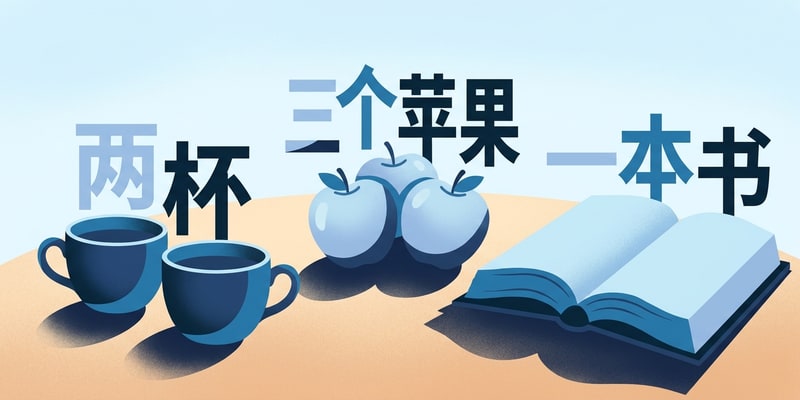
Learning to count in Chinese is fast. Learning to use numbers in real sentences — that's where it gets interesting.
If you want the full 1–100 reference table, keep Chinese Numbers 1–100 open next to this post. For the big-picture logic (including 万 grouping), read Mandarin Numbers: The Complete Guide.
The piece most learners miss isn't the numbers themselves (those are logical and easy to memorise). It's measure words — the classifier words that go between a number and a noun in Mandarin. Without them, your counting sounds wrong even if the numbers are correct.
Numbers 1–10: The Core
| Number | Hanzi | Pinyin |
|---|---|---|
| 1 | 一 | yī |
| 2 | 二 | èr |
| 3 | 三 | sān |
| 4 | 四 | sì |
| 5 | 五 | wǔ |
| 6 | 六 | liù |
| 7 | 七 | qī |
| 8 | 八 | bā |
| 9 | 九 | jiǔ |
| 10 | 十 | shí |
Beyond 10, the system is fully logical: 11 is 十一 (ten-one), 20 is 二十 (two-ten), 35 is 三十五 (three-ten-five). No exceptions.
Measure Words: The Part Nobody Explains Well
In English, you can say "three dogs," "two beers," "one book" — the noun stands alone. In Mandarin, a classifier word must go between the number and the noun. The classifier changes depending on the category of noun.
个 (gè) — the general-purpose measure word. When in doubt, use this. It works for people and many objects.
- 三个朋友 (sān gè péngyǒu) — three friends
- 两个苹果 (liǎng gè píngguǒ) — two apples
杯 (bēi) — for cups and glasses of liquid
- 一杯咖啡 (yī bēi kāfēi) — one coffee
- 两杯水 (liǎng bēi shuǐ) — two waters
本 (běn) — for books and bound items
- 三本书 (sān běn shū) — three books
条 (tiáo) — for long, flexible things (fish, roads, trousers)
- 两条鱼 (liǎng tiáo yú) — two fish
张 (zhāng) — for flat things (tables, paper, tickets)
- 一张票 (yī zhāng piào) — one ticket
只 (zhī) — for small animals, and one of a pair
- 三只猫 (sān zhī māo) — three cats
The honest truth: native speakers are forgiving about measure word errors, especially from non-native learners. Getting the number right and using 个 as a fallback will carry you a long way. Learn the specific classifiers as you encounter them in context.
💡Measure words are the bridge between "I know digits" and "I sound natural in a shop or cafe."
Try building a Counting & Classifiers island on LingoIsland — free to start, no experience needed.
Try it free →两 (liǎng) vs 二 (èr): The Number Two Problem
This confuses nearly every learner. There are two ways to say "two" and they're used in different situations.
二 (èr) — use when counting, in compound numbers, and in formal contexts
两 (liǎng) — use before measure words (i.e., when saying "two of something")
- Counting: 一, 二, 三... (yī, èr, sān)
- Two coffees: 两杯咖啡 (liǎng bēi kāfēi)
- Number 12: 十二 (shí èr)
- Two people: 两个人 (liǎng gè rén)
Numbers in Everyday Situations
Prices: 三十五块 (sānshíwǔ kuài) — 35 yuan. 块 (kuài) is the colloquial word for 元 (yuán).
Time: 三点半 (sān diǎn bàn) — 3:30. 点 (diǎn) means "o'clock," 半 (bàn) means "half."
Dates: 五月十三号 (wǔ yuè shísān hào) — May 13th. 号 (hào) is the measure word for dates.
Phone numbers: Said digit by digit, just like English. The key difference: 1 is often said as 幺 (yāo) instead of 一 (yī) in phone numbers to avoid confusion.
💡Measure words come up in almost every topic-specific conversation — ordering food, shopping, talking about your pets. If you want to build vocabulary around a specific area of your life, LingoIsland generates real example sentences that show measure words in natural context.
Pick any topic and practise in context.
Try it free — pick any topic →About the author
Cameron — Founder of LingoIsland & Mandarin learner (HSK 5). Read Cameron's story.