Vocabulary
How to Express Gratitude in Chinese (Beyond 谢谢)
5 min read

Everyone learns 谢谢 (xièxiè) on day one. It's the obvious starting point and it works — native speakers appreciate any effort to say thank you in Mandarin.
But if you've been learning for a while and want your gratitude to sound genuine rather than tourist-level, there's a richer vocabulary worth knowing. Different situations call for different expressions, and getting this right is one of the quickest ways to sound more natural.
The Basics
| Expression | Pinyin | Meaning / When to use |
|---|---|---|
| 谢谢 | xièxiè | Thank you — universal, always appropriate |
| 谢谢你 | xièxiè nǐ | Thank you (to one person, slightly warmer) |
| 谢谢您 | xièxiè nín | Thank you (formal/respectful — to elders, bosses) |
| 多谢 | duō xiè | Many thanks — slightly more emphatic, common in Cantonese-influenced areas |
| 非常感谢 | fēicháng gǎnxiè | Thank you very much — formal situations |
When Someone Does Something Significant
| Expression | Pinyin | Meaning |
|---|---|---|
| 感谢你 | gǎnxiè nǐ | I'm grateful to you — more heartfelt than 谢谢 |
| 太感谢了 | tài gǎnxiè le | I'm so grateful — genuine emotional weight |
| 真的很感谢 | zhēn de hěn gǎnxiè | Truly very grateful — use for meaningful help |
| 感激不尽 | gǎnjī bù jìn | Endlessly grateful — written/formal contexts |
Responding to Thanks
Knowing how to respond when someone thanks you is just as important.
| Response | Pinyin | Meaning |
|---|---|---|
| 不客气 | bù kèqi | You're welcome — the classic response |
| 没事 | méi shì | No problem / it's nothing |
| 没关系 | méi guānxi | Don't worry about it |
| 哪里哪里 | nǎlǐ nǎlǐ | Not at all — modest, slightly old-fashioned |
| 应该的 | yīnggāi de | It's what I should do — warm and generous feeling |
In Specific Situations
At a restaurant or shop: 谢谢 is always appropriate. For particularly good service, 非常感谢 (fēicháng gǎnxiè) lands nicely.
After someone helps you with something significant: 真的很感谢你的帮助 (zhēn de hěn gǎnxiè nǐ de bāngzhù) — "I'm truly very grateful for your help."
In a professional email: 感谢您的支持 (gǎnxiè nín de zhīchí) — "Thank you for your support."
After a meal at someone's home: 谢谢你的款待 (xièxiè nǐ de kuǎndài) — "Thank you for your hospitality."
💡Gratitude is one of LingoIsland's ready-to-build topic islands — meaning you can generate a full set of vocabulary around thanks, compliments, and polite small talk in seconds.
Try building a Gratitude island on LingoIsland — free to start, no experience needed.
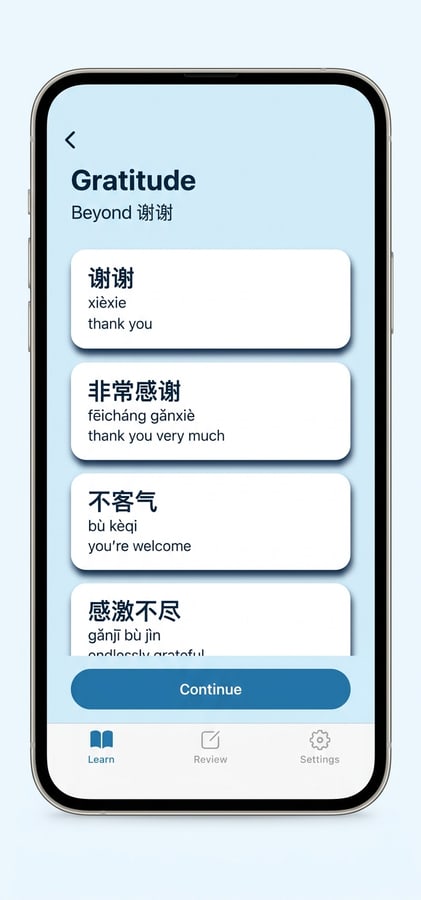
A Gratitude island on LingoIsland
A Note on Cultural Context
In Chinese culture, gratitude is sometimes expressed more through action than words — reciprocating a favour, bringing a gift, or treating someone to a meal can carry more weight than verbal thanks alone. That said, native speakers genuinely appreciate hearing gratitude expressed warmly and specifically, especially from non-native learners who make the effort.
💡If you want a tight set of polite phrases you can rehearse until they feel automatic, pick Gratitude (or a broader Social Mandarin topic) and quiz yourself in short sessions.
Free to start — no experience needed.
Start your first island free →About the author
Cameron — Founder of LingoIsland & Mandarin learner (HSK 5). Read Cameron's story.